par
yyy666 » 07 mars 2024, 10:19
Hello, j'ai une petite question.
J'ai mis en place un formulaire d'inscription (Form Registration) qui fonctionne parfaitement. Cependant, je souhaite créer des comptes via EasyAdmin. Donc, je crée les comptes avec la fonction 'Create' d'EasyAdmin. Les comptes sont bien enregistrés en base de données, mais le mot de passe n'est pas crypté (hashé) et les utilisateurs ne parviennent pas à se connecter. D'où pourrait bien venir le problème ? SVP.
Voici quelques extraits :

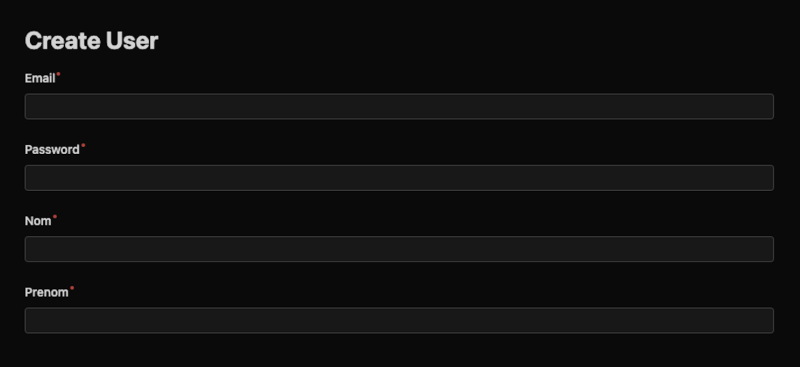
RegistrationController.php
<?php

namespace App\Controller;

use App\Entity\User;
use App\Form\RegistrationFormType;
use App\Security\UserAuthenticator;
use Doctrine\ORM\EntityManagerInterface;
use Symfony\Bundle\FrameworkBundle\Controller\AbstractController;
use Symfony\Component\HttpFoundation\Request;
use Symfony\Component\HttpFoundation\Response;
use Symfony\Component\PasswordHasher\Hasher\UserPasswordHasherInterface;
use Symfony\Component\Routing\Attribute\Route;
use Symfony\Component\Security\Http\Authentication\UserAuthenticatorInterface;

class RegistrationController extends AbstractController
{
    #[Route('/inscription', name: 'app_register')]
    public function register(Request $request, UserPasswordHasherInterface $userPasswordHasher, UserAuthenticatorInterface $userAuthenticator, UserAuthenticator $authenticator, EntityManagerInterface $entityManager): Response
    {
        $user = new User();
        $form = $this->createForm(RegistrationFormType::class, $user);
        $form->handleRequest($request);

        if ($form->isSubmitted() && $form->isValid()) {
            // encode the plain password
            $user->setPassword(
                $userPasswordHasher->hashPassword(
                    $user,
                    $form->get('plainPassword')->getData()
                )
            );

            $entityManager->persist($user);
            $entityManager->flush();
            // do anything else you need here, like send an email

            return $userAuthenticator->authenticateUser(
                $user,
                $authenticator,
                $request
            );
        }

        return $this->render('registration/register.html.twig', [
            'registrationForm' => $form,
        ]);
    }
}
User.php
<?php

namespace App\Entity;

use App\Repository\UserRepository;
use Doctrine\ORM\Mapping as ORM;
use Symfony\Bridge\Doctrine\Validator\Constraints\UniqueEntity;
use Symfony\Component\Security\Core\User\PasswordAuthenticatedUserInterface;
use Symfony\Component\Security\Core\User\UserInterface;

#[ORM\Entity(repositoryClass: UserRepository::class)]
#[UniqueEntity(fields: ['email'], message: 'There is already an account with this email')]
class User implements UserInterface, PasswordAuthenticatedUserInterface
{
    #[ORM\Id]
    #[ORM\GeneratedValue]
    #[ORM\Column]
    private ?int $id = null;

    #[ORM\Column(length: 180, unique: true)]
    private ?string $email = null;

    /**
     * @var list<string> The user roles
     */
    #[ORM\Column]
    private array $roles = [];

    /**
     * @var string The hashed password
     */
    #[ORM\Column]
    private ?string $password = null;

    #[ORM\Column(length: 255)]
    private ?string $nom = null;

    #[ORM\Column(length: 255)]
    private ?string $prenom = null;

    public function getId(): ?int
    {
        return $this->id;
    }

    public function getEmail(): ?string
    {
        return $this->email;
    }

    public function setEmail(string $email): static
    {
        $this->email = $email;

        return $this;
    }

    /**
     * A visual identifier that represents this user.
     *
     * @see UserInterface
     */
    public function getUserIdentifier(): string
    {
        return (string) $this->email;
    }

    /**
     * @see UserInterface
     *
     * @return list<string>
     */
    public function getRoles(): array
    {
        $roles = $this->roles;
        // guarantee every user at least has ROLE_USER
        $roles[] = 'ROLE_USER';

        return array_unique($roles);
    }

    /**
     * @param list<string> $roles
     */
    public function setRoles(array $roles): static
    {
        $this->roles = $roles;

        return $this;
    }

    /**
     * @see PasswordAuthenticatedUserInterface
     */
    public function getPassword(): string
    {
        return $this->password;
    }

    public function setPassword(string $password): static
    {
        $this->password = $password;

        return $this;
    }

    /**
     * @see UserInterface
     */
    public function eraseCredentials(): void
    {
        // If you store any temporary, sensitive data on the user, clear it here
        // $this->plainPassword = null;
    }

    public function getNom(): ?string
    {
        return $this->nom;
    }

    public function setNom(string $nom): static
    {
        $this->nom = $nom;

        return $this;
    }

    public function getPrenom(): ?string
    {
        return $this->prenom;
    }

    public function setPrenom(string $prenom): static
    {
        $this->prenom = $prenom;

        return $this;
    }

}
UserCrudController.php
<?php

namespace App\Controller\Admin;

use App\Entity\User;
use EasyCorp\Bundle\EasyAdminBundle\Controller\AbstractCrudController;
use EasyCorp\Bundle\EasyAdminBundle\Field\IdField;
use EasyCorp\Bundle\EasyAdminBundle\Field\TextEditorField;
use EasyCorp\Bundle\EasyAdminBundle\Field\TextField;

class UserCrudController extends AbstractCrudController
{
    public static function getEntityFqcn(): string
    {
        return User::class;
    }


    /*
    public function configureFields(string $pageName): iterable
    {
        return [
            IdField::new('id'),
            TextField::new('title'),
            TextEditorField::new('description'),
        ];
    }
    */
}
DashBoardController.php
<?php

namespace App\Controller\Admin;

use App\Entity\Article;
use App\Entity\Categorie;
use App\Entity\SousCategorie;
use App\Entity\User;
use EasyCorp\Bundle\EasyAdminBundle\Config\Dashboard;
use EasyCorp\Bundle\EasyAdminBundle\Config\MenuItem;
use EasyCorp\Bundle\EasyAdminBundle\Controller\AbstractDashboardController;
use EasyCorp\Bundle\EasyAdminBundle\Router\AdminUrlGenerator;
use Symfony\Component\HttpFoundation\Response;
use Symfony\Component\Routing\Annotation\Route;

class DashboardController extends AbstractDashboardController
{
    #[Route('/admin', name: 'admin')]
    public function index(): Response
    {

        $adminUrlGenerator = $this->container->get(AdminUrlGenerator::class);
        return $this->redirect($adminUrlGenerator->setController(CategorieCrudController::class)->generateUrl());

    }

    public function configureDashboard(): Dashboard
    {
        return Dashboard::new()
            ->setTitle('Lewikidegti');
    }

    public function configureMenuItems(): iterable
    {
        yield MenuItem::linkToCrud('Categories', 'fas fa-list', Categorie::class);
        yield MenuItem::linkToCrud('SousCategories', 'fas fa-list', SousCategorie::class);
        yield MenuItem::linkToCrud('Articles', 'fas fa-list', Article::class);
        yield MenuItem::linkToCrud('Users', 'fas fa-list', User::class);
    }
}
RegistrationFormType
<?php

namespace App\Form;

use App\Entity\User;
use Symfony\Component\Form\AbstractType;
use Symfony\Component\Form\Extension\Core\Type\CheckboxType;
use Symfony\Component\Form\Extension\Core\Type\PasswordType;
use Symfony\Component\Form\FormBuilderInterface;
use Symfony\Component\OptionsResolver\OptionsResolver;
use Symfony\Component\Validator\Constraints\IsTrue;
use Symfony\Component\Validator\Constraints\Length;
use Symfony\Component\Validator\Constraints\NotBlank;

class RegistrationFormType extends AbstractType
{
    public function buildForm(FormBuilderInterface $builder, array $options): void
    {
        $builder
            ->add('prenom', null, [
                'label' => false,
                'attr' => ['placeholder' => 'Prénom'],
            ])
            ->add('nom', null, [
                'label' => false,
                'attr' => ['placeholder' => 'Nom'],
            ])
            ->add('email', null, [
                'label' => false,
                'attr' => ['placeholder' => 'Adresse e-mail'],
            ])

            ->add('plainPassword', PasswordType::class, [
                // instead of being set onto the object directly,
                // this is read and encoded in the controller
                'label' => false,
                'mapped' => false,
                'attr' => ['autocomplete' => 'new-password', 'placeholder' => 'Mot de passe'],
                'constraints' => [
                    new NotBlank([
                        'message' => 'Please enter a password',
                    ]),
                    new Length([
                        'min' => 6,
                        'minMessage' => 'Your password should be at least {{ limit }} characters',
                        // max length allowed by Symfony for security reasons
                        'max' => 4096,
                    ]),
                ],
            ]);
    }

    public function configureOptions(OptionsResolver $resolver): void
    {
        $resolver->setDefaults([
            'data_class' => User::class,
        ]);
    }
}
Hello, j'ai une petite question.
J'ai mis en place un formulaire d'inscription (Form Registration) qui fonctionne parfaitement. Cependant, je souhaite créer des comptes via EasyAdmin. Donc, je crée les comptes avec la fonction 'Create' d'EasyAdmin. Les comptes sont bien enregistrés en base de données, mais le mot de passe n'est pas crypté (hashé) et les utilisateurs ne parviennent pas à se connecter. D'où pourrait bien venir le problème ? SVP.
Voici quelques extraits :
[url=https://goopics.net/i/5ia4qr][img]https://i.goopics.net/800/5ia4qr.png[/img][/url]
[url=https://goopics.net/i/35mjoz][img]https://i.goopics.net/800/35mjoz.png[/img][/url]
RegistrationController.php
[PHP]
<?php
namespace App\Controller;
use App\Entity\User;
use App\Form\RegistrationFormType;
use App\Security\UserAuthenticator;
use Doctrine\ORM\EntityManagerInterface;
use Symfony\Bundle\FrameworkBundle\Controller\AbstractController;
use Symfony\Component\HttpFoundation\Request;
use Symfony\Component\HttpFoundation\Response;
use Symfony\Component\PasswordHasher\Hasher\UserPasswordHasherInterface;
use Symfony\Component\Routing\Attribute\Route;
use Symfony\Component\Security\Http\Authentication\UserAuthenticatorInterface;
class RegistrationController extends AbstractController
{
#[Route('/inscription', name: 'app_register')]
public function register(Request $request, UserPasswordHasherInterface $userPasswordHasher, UserAuthenticatorInterface $userAuthenticator, UserAuthenticator $authenticator, EntityManagerInterface $entityManager): Response
{
$user = new User();
$form = $this->createForm(RegistrationFormType::class, $user);
$form->handleRequest($request);
if ($form->isSubmitted() && $form->isValid()) {
// encode the plain password
$user->setPassword(
$userPasswordHasher->hashPassword(
$user,
$form->get('plainPassword')->getData()
)
);
$entityManager->persist($user);
$entityManager->flush();
// do anything else you need here, like send an email
return $userAuthenticator->authenticateUser(
$user,
$authenticator,
$request
);
}
return $this->render('registration/register.html.twig', [
'registrationForm' => $form,
]);
}
}
[/PHP]
User.php
[PHP]
<?php
namespace App\Entity;
use App\Repository\UserRepository;
use Doctrine\ORM\Mapping as ORM;
use Symfony\Bridge\Doctrine\Validator\Constraints\UniqueEntity;
use Symfony\Component\Security\Core\User\PasswordAuthenticatedUserInterface;
use Symfony\Component\Security\Core\User\UserInterface;
#[ORM\Entity(repositoryClass: UserRepository::class)]
#[UniqueEntity(fields: ['email'], message: 'There is already an account with this email')]
class User implements UserInterface, PasswordAuthenticatedUserInterface
{
#[ORM\Id]
#[ORM\GeneratedValue]
#[ORM\Column]
private ?int $id = null;
#[ORM\Column(length: 180, unique: true)]
private ?string $email = null;
/**
* @var list<string> The user roles
*/
#[ORM\Column]
private array $roles = [];
/**
* @var string The hashed password
*/
#[ORM\Column]
private ?string $password = null;
#[ORM\Column(length: 255)]
private ?string $nom = null;
#[ORM\Column(length: 255)]
private ?string $prenom = null;
public function getId(): ?int
{
return $this->id;
}
public function getEmail(): ?string
{
return $this->email;
}
public function setEmail(string $email): static
{
$this->email = $email;
return $this;
}
/**
* A visual identifier that represents this user.
*
* @see UserInterface
*/
public function getUserIdentifier(): string
{
return (string) $this->email;
}
/**
* @see UserInterface
*
* @return list<string>
*/
public function getRoles(): array
{
$roles = $this->roles;
// guarantee every user at least has ROLE_USER
$roles[] = 'ROLE_USER';
return array_unique($roles);
}
/**
* @param list<string> $roles
*/
public function setRoles(array $roles): static
{
$this->roles = $roles;
return $this;
}
/**
* @see PasswordAuthenticatedUserInterface
*/
public function getPassword(): string
{
return $this->password;
}
public function setPassword(string $password): static
{
$this->password = $password;
return $this;
}
/**
* @see UserInterface
*/
public function eraseCredentials(): void
{
// If you store any temporary, sensitive data on the user, clear it here
// $this->plainPassword = null;
}
public function getNom(): ?string
{
return $this->nom;
}
public function setNom(string $nom): static
{
$this->nom = $nom;
return $this;
}
public function getPrenom(): ?string
{
return $this->prenom;
}
public function setPrenom(string $prenom): static
{
$this->prenom = $prenom;
return $this;
}
}
[/PHP]
UserCrudController.php
[PHP]
<?php
namespace App\Controller\Admin;
use App\Entity\User;
use EasyCorp\Bundle\EasyAdminBundle\Controller\AbstractCrudController;
use EasyCorp\Bundle\EasyAdminBundle\Field\IdField;
use EasyCorp\Bundle\EasyAdminBundle\Field\TextEditorField;
use EasyCorp\Bundle\EasyAdminBundle\Field\TextField;
class UserCrudController extends AbstractCrudController
{
public static function getEntityFqcn(): string
{
return User::class;
}
/*
public function configureFields(string $pageName): iterable
{
return [
IdField::new('id'),
TextField::new('title'),
TextEditorField::new('description'),
];
}
*/
}
[/PHP]
DashBoardController.php
[PHP]
<?php
namespace App\Controller\Admin;
use App\Entity\Article;
use App\Entity\Categorie;
use App\Entity\SousCategorie;
use App\Entity\User;
use EasyCorp\Bundle\EasyAdminBundle\Config\Dashboard;
use EasyCorp\Bundle\EasyAdminBundle\Config\MenuItem;
use EasyCorp\Bundle\EasyAdminBundle\Controller\AbstractDashboardController;
use EasyCorp\Bundle\EasyAdminBundle\Router\AdminUrlGenerator;
use Symfony\Component\HttpFoundation\Response;
use Symfony\Component\Routing\Annotation\Route;
class DashboardController extends AbstractDashboardController
{
#[Route('/admin', name: 'admin')]
public function index(): Response
{
$adminUrlGenerator = $this->container->get(AdminUrlGenerator::class);
return $this->redirect($adminUrlGenerator->setController(CategorieCrudController::class)->generateUrl());
}
public function configureDashboard(): Dashboard
{
return Dashboard::new()
->setTitle('Lewikidegti');
}
public function configureMenuItems(): iterable
{
yield MenuItem::linkToCrud('Categories', 'fas fa-list', Categorie::class);
yield MenuItem::linkToCrud('SousCategories', 'fas fa-list', SousCategorie::class);
yield MenuItem::linkToCrud('Articles', 'fas fa-list', Article::class);
yield MenuItem::linkToCrud('Users', 'fas fa-list', User::class);
}
}
[/PHP]
RegistrationFormType
[PHP]
<?php
namespace App\Form;
use App\Entity\User;
use Symfony\Component\Form\AbstractType;
use Symfony\Component\Form\Extension\Core\Type\CheckboxType;
use Symfony\Component\Form\Extension\Core\Type\PasswordType;
use Symfony\Component\Form\FormBuilderInterface;
use Symfony\Component\OptionsResolver\OptionsResolver;
use Symfony\Component\Validator\Constraints\IsTrue;
use Symfony\Component\Validator\Constraints\Length;
use Symfony\Component\Validator\Constraints\NotBlank;
class RegistrationFormType extends AbstractType
{
public function buildForm(FormBuilderInterface $builder, array $options): void
{
$builder
->add('prenom', null, [
'label' => false,
'attr' => ['placeholder' => 'Prénom'],
])
->add('nom', null, [
'label' => false,
'attr' => ['placeholder' => 'Nom'],
])
->add('email', null, [
'label' => false,
'attr' => ['placeholder' => 'Adresse e-mail'],
])
->add('plainPassword', PasswordType::class, [
// instead of being set onto the object directly,
// this is read and encoded in the controller
'label' => false,
'mapped' => false,
'attr' => ['autocomplete' => 'new-password', 'placeholder' => 'Mot de passe'],
'constraints' => [
new NotBlank([
'message' => 'Please enter a password',
]),
new Length([
'min' => 6,
'minMessage' => 'Your password should be at least {{ limit }} characters',
// max length allowed by Symfony for security reasons
'max' => 4096,
]),
],
]);
}
public function configureOptions(OptionsResolver $resolver): void
{
$resolver->setDefaults([
'data_class' => User::class,
]);
}
}
[/PHP]
